
What good form actually looks like
Good form is not a vague standard. A correct repetition has a shape you can see from outside, and three things decide it. This page takes them one at a time, with the cues I use in the room.
Bad form does not just waste the set. It puts your body at real risk of injury. Keeping every joint properly aligned throughout an exercise is what decides whether it helps you or hurts you.
Three things a good rep gets right
Position, range and speed. Brace your core and tuck your ribs down before you squat. Sit back further, aim for thighs at least parallel to the floor. Then control the way down instead of dropping into it.
Get all three right and the muscle you meant to work is the one working. Get one wrong and the joint takes the load, which is what raises injury risk in the first place.

Form has to hold for all three phases
The lifting half of a rep is concentric. The lowering half is eccentric, the muscle lengthening under load. A hold is isometric, the muscle under load with nothing moving. A plank and a wall sit are both holds.
A hold has form too. On a plank, keep your body in one straight line, brace your core, do not let your hips drop. Keep your hips level with your shoulders, do not pike up.

How far a rep should travel
Stopping short is a fault that hides, because the weight still moves. You will hear fully extend your arms at the bottom of each rep. On a leg raise, aim for at least a 90 degree angle at the hip.
More is not always better. On a lateral raise, stop at shoulder height, because raising higher shifts the load onto your traps. This exercise is about control, not range.

The joint that should be moving
On most isolation work one joint moves and the rest hold still. For a concentration curl, keep your elbow braced against your inner thigh, only your forearm should move.
For a triceps kickback, keep your upper arm still and parallel to the floor, only extend from the elbow. When a second joint joins in, the target muscle has quietly handed the work away.

Momentum is the easiest fault to see
A rep driven by a swing is not a rep. On a dumbbell raise you will hear keep your torso still, this is a slow, controlled raise, not a swing.
On a step-up, drive up through the stepping leg, do not push off or lean forward with momentum. If the weight needs a swing to move, the weight is the problem, not your effort.
Your trainer
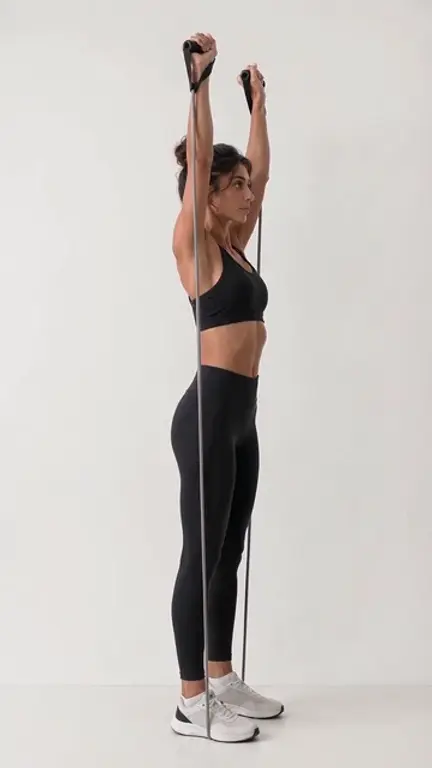
Five certifications: NASM CPT and Master Trainer, NASM-CES, NASM-PES, NCSF and PFIT, plus a current CPR card. I have trained clients since 2005 and founded OC Personal Training in Irvine in 2008.
NASM-CES is the corrective exercise credential behind the form calls, and a call that comes during the set is worth more than a note afterwards. Working the movement pattern with a professional before adding load is the job here.

What your heels are telling you
Watch the floor. If your heels lift as you squat, the rep has already changed. Keep your heels planted, shift your weight back through mid-foot, and walk your feet out slightly so your knees stay above your ankles.
Heels that rise usually point at a short soleus and a weak anterior tibialis. That is why the stance changes before the weight does. If you have a condition, get cleared by your own doctor first.

A strong rep can still be wrong
Form that feels powerful is sometimes a tight muscle doing someone else's job. On a knee drive, drive your knee straight up in line with your hip, not caving inward.
A knee that drifts in usually means a short adductor complex and TFL with a weak gluteus medius and VMO. The position gets fixed before the weight goes up, because a position you cannot hold is not strength yet.

Good form holds up in three planes
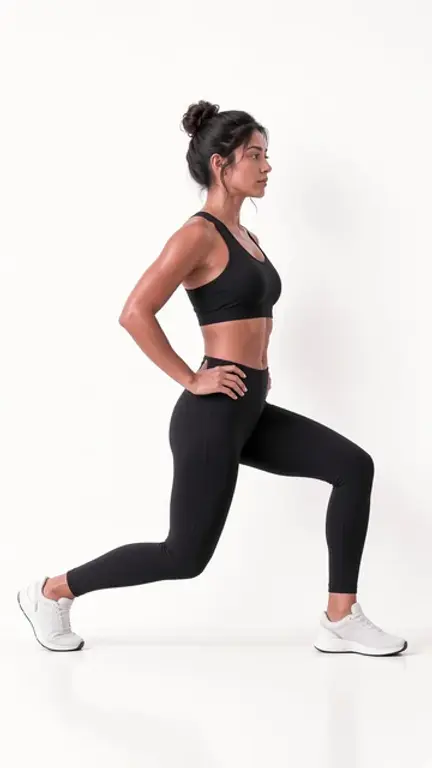
Real movement happens in three planes and most workouts only train one of them. Sagittal is forward and back, like a squat. Frontal is side to side, like a lateral lunge. Transverse is rotation.
On a rotation, keep your hips facing forward, rotate through your torso, not your hips. Rotate further so your elbow actually reaches toward your opposite knee. Training all three planes is what builds movement that holds up outside the studio.
When form is the reason to change
Your body adapts to whatever you throw at it, quickly. Stick with the exact same routine and your progress stalls, because your body has already adapted and stopped being challenged.
The other reason is form itself. A pattern that breaks before your muscles do is worth an hour of someone watching it. I train on the NASM OPT model, from the basics and progressively advancing. Individual results vary.

Questions
How do I know my form is off
You often cannot, from inside the rep. A rep that cheats usually feels easier, not harder. A mirror gives you one angle, and a heel that lifts shows from the side.
Should I lift lighter to learn form
Usually yes. Work the pattern first, then add load once the position holds for every rep of the set. Bad reps under heavy weight are the ones that cost you.
How slow should the lowering be
Slow enough that you control it the whole way. The lowering half is where a lot of muscle damage and growth stimulus actually happens, so rushing it gives away the best part of the set.
Can I check my form at home
VeraForma, my app, checks your form through your phone camera, and the cues it calls are the ones I say in the room. Premium comes with every studio plan. It is practice between sessions, not a replacement for one.
What does the free first session cover
Goals, a posture and movement check, and a short workout. I ask what areas do you want to improve most, and why. Then you get a plan. No card, no obligation.

Book your free session
Form work happens at the private studio, 17165 Von Karman Ave, Suite 103, Irvine, CA 92614. Open Monday to Friday, 6 AM to 8 PM, and closed Saturday and Sunday.
Call (949) 574-4755, or leave your name, email and phone. Brad will call you within 1 business day to book a time. The first hour is one-on-one and free.
